
Sandusky County Three-Day Release Records
The Sandusky County Sheriff's Office publishes a current-only PDF, not an official 72-hour released-inmate list. The report is dated when rendered, yet no official update-frequency promise or archive was found. Its purpose is current custody. It has no verified release-date field and cannot be filtered to a three-day window. Comparing several copies may suggest that a name disappeared, but it cannot distinguish community release from transfer, changed identifiers, or a report refresh.
A useful three-day search asks for existing release logs, release screens, or booking and custody records responsive to exact endpoints. The range should use America/New_York local time and state both the beginning and end. This is especially important over a weekend, when the window may begin on one calendar date and end after courts reopen. The custodian need not create a custom list that does not exist, but can identify responsive records it already keeps.
Check Sandusky County 72-Hour Releases
Build the interval before contacting the jail. “The last three days” can mean a rolling period ending now or three full calendar dates. Clear timestamps reduce uncertainty and help prevent an event near midnight from being omitted. A booking number is also valuable because one person can have more than one booking and exit in the same broad period.
- Write the start and end in local time, including the date, hour, and minute. State whether the range is rolling or calendar based.
- Check the current sheriff PDF only for present inclusion. Do not treat absence as an exit record.
- Contact the Sandusky County Jail at 419-332-2613 or use the county's public-record process. Ask for an existing release log or responsive booking and custody records.
- Identify the person and booking episode. Request the release timestamp, authority or reason, court and case number, and any receiving agency or hold disposition.
- Check the combined county docket or the separate Fremont Municipal docket, based on where the case was filed. Read the chronological entries rather than relying on a charge label alone.
- If the exit was a transfer, continue with the receiving system. ODRC tracks state custody, while another county or federal agency controls its own record.
The Sandusky County 24-hour release process is better for a tightly defined same-day interval. The three-day method is designed for volume and cross-day ambiguity. It may produce more responsive records, so the booking identifier and exact endpoints become more important.
Note: Ask for an existing report or record class because Ohio public-records law does not require the sheriff to compile a new 72-hour list.
Sandusky County Three-Day Fields
Because Sandusky County has no online three-day feed, these are the fields to seek in the underlying records. They let a reader sort multiple booking episodes, test whether an exit falls within the range, and determine whether the next step was community release or continued custody elsewhere.
| Field | What it shows |
|---|---|
| Name, alias, date of birth, or jail ID | The identity attached to the custody episode. |
| Booking number and booking timestamp | Which jail stay produced the later release entry. |
| Release date and time | Whether the exit sits within the exact 72-hour endpoints. |
| Release type or authority | Bond, court order, time served, sentence expiration, transfer, or another reason. |
| Court and case number | The docket that explains the legal basis for the action. |
| Destination, transfer agency, or hold disposition | Whether the person entered another custodial or supervised setting. |
The current PDF displays Jail ID, name, SID, attorney, book date, age, arresting agency, charge, court, current disposition, and total bail. It does not show a booking photograph or release date in the verified render. A bond or dismissal label on one charge does not prove the jail discharged the person. Another charge or warrant can keep the person in custody.
Sandusky Weekend Release Timing
A three-day Sandusky County release range is most useful when it crosses days on which court counters are closed. The jail's physical action, the docket posting, and the public PDF refresh are separate events. A judge may authorize bond or another action before a web docket reflects it. Fremont Municipal Court expressly warns that its online posting can lag by at least a day and sometimes longer.
That delay does not move the actual release into a later date. Ask the sheriff for the custody timestamp, then use the court entry to explain the authority. If the range ends before a clerk posts an entry, check the docket again after the office reopens or request the journal entry. This method preserves the real exit time without treating the online posting time as the release.
A wider period also catches repeat episodes. One person might leave after bond and later return on another matter. Group records by booking number and date, not name alone. When a transfer occurs late in the range, the receiving agency's record may begin on the next date even though Sandusky County custody ended earlier.
Sandusky County Release Fallback Chain
The first fallback is the sheriff's own custody record. The county's optional SCPR-10 form accepts a record description and offers onsite inspection, paper or mailed copies, downloads, optical media, a USB device, and email. The form can also ask for the relevant RC-2 retention schedule. A name, one disambiguator, the booking range, and the desired release fields make the request more precise.
Next, choose the court system. The Sandusky County Clerk combined docket includes felony Common Pleas cases and County Court matters in Clyde and Woodville. Fremont Municipal CaseLook is separate, and a felony can appear there at the preliminary stage before moving to Common Pleas. The court order explains a bond, dismissal, sentence, or transfer. The jail record proves the physical exit.
Ohio VINE is useful for prospective notice when the specific person and reporting agency appear in the live service. ODRC applies only if the person entered state prison or state supervision. Neither route replaces the county release record for an ordinary local jail discharge. For a complete named-person route, use the Sandusky County release-record search rather than turning the three-day request into a general person search.
Sandusky Release Roster Limits
The dated current-only PDF creates a common trap. A person can appear on one copy and not on the next, but the comparison does not state why. Community release, ODRC transfer, movement to another jail, a spelling change, or a report process can all produce the same visible result. There is no public Sandusky County retention window for former names because the report does not present former detainees at all.
The official sheriff page remains the correct source for the current report and agency information.
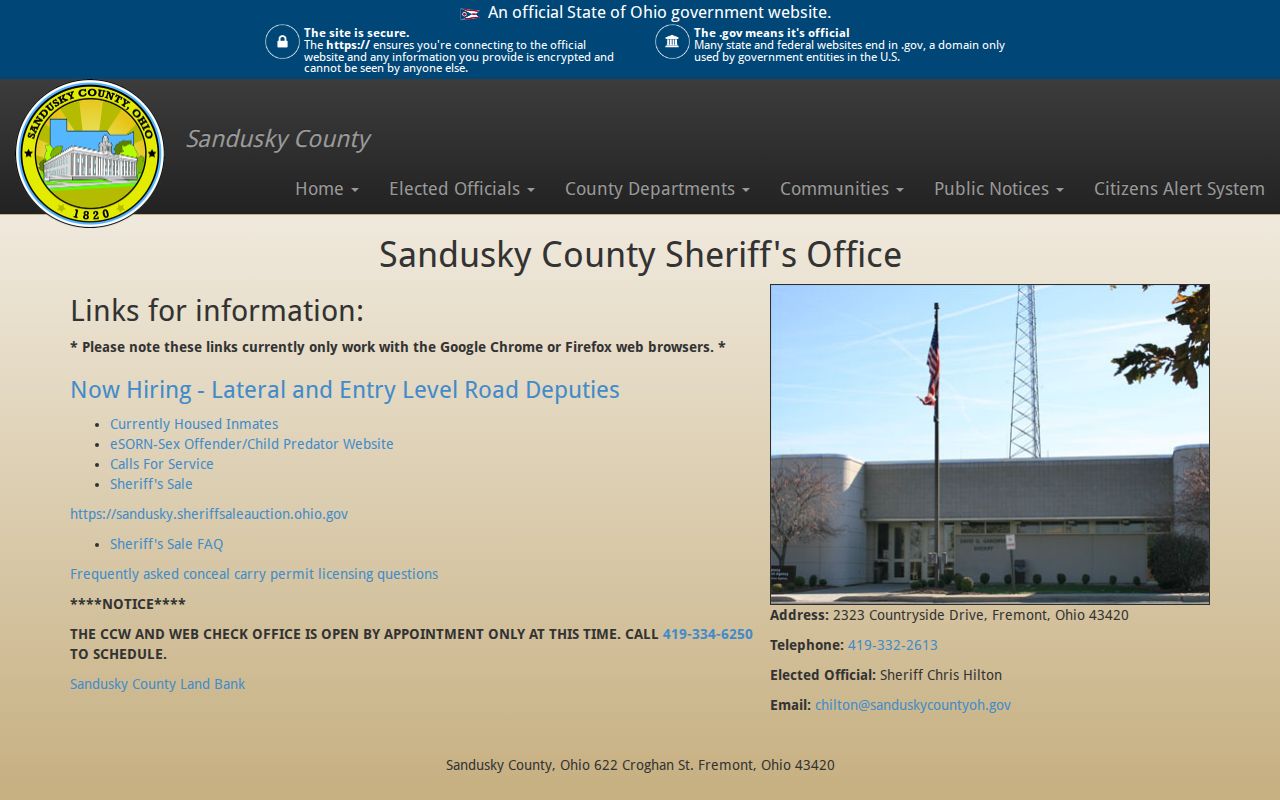
The page supports a current-custody check, while an exact three-day release range must come from the underlying custody or release records.
Search-engine copies and cached PDFs are not county-certified archives. They can be stale and may preserve a charge after its status changed. Ask the record custodian for the underlying material and the applicable retention schedule when the requested period is older.
Note: A three-day roster comparison cannot identify the exit reason, receiving agency, or exact time without the sheriff's booking and custody record.
Sandusky County Release Destinations
Every release record should be read for destination. A bond release or local sentence completion may lead to the community, perhaps under pretrial or probation terms. A transfer to ODRC means state custody continues. Placement at a community-based correctional facility can mean the person is off the county jail roster while still in a structured correctional setting.
| Record result | Next source |
|---|---|
| Bond or recognizance release | Local court docket and sheriff exit record |
| Time-served or sentence discharge | Sentencing entry, jail-time credit, and sheriff exit record |
| Transfer to ODRC | ODRC offender search by name or offender number |
| Transfer to another agency | Receiving agency record and transfer disposition |
| Community-control placement | Court journal and responsible supervision office |
These paths explain why “not on the current report” and “fully discharged” are not equal statements. The three-day request should capture the Sandusky County exit first, then follow the destination until the custody or supervision status is clear.
Juvenile records require a different path. Sandusky County Juvenile Justice Center release or placement information is handled through Juvenile Court and authorized channels, not the adult jail PDF. The regional Northern Ohio Juvenile Community Corrections Facility also serves county youth, but it sits in the city of Sandusky in Erie County. Adult public-record tools should not be treated as a substitute for confidential youth procedures.
CROSSWAEH in Tiffin presents another local distinction. A Sandusky County court can place an eligible person there, and a move from jail to that structured program is not a full discharge. Completion may lead to community supervision, while termination can return the matter to the sentencing court. The court journal, facility record, and responsible supervision office explain that path.