
Juvenile Center Release Confidentiality
Release and placement information for a youth is handled under juvenile confidentiality rules. Sandusky County Juvenile Court controls what can be shared, with whom, and through which process. The adult Sandusky County Jail report is not a back door to juvenile information. It does not provide equivalent coverage, and the absence of a youth from that report says nothing about a Juvenile Justice Center release.
Parents, guardians, attorneys, custodians, and other people with a recognized role should use the contact directions supplied by the court or facility. The responsible office may need to confirm identity and authority before discussing a youth. A general member of the public should not expect an adult-style roster, a released-youth list, or a public search result. No pseudo-roster should be built from court mentions, news reports, or scattered records.
The official Sandusky County Juvenile Court detention page identifies the center and is the proper public starting point. It does not create a right to confidential case or placement details.
Juvenile Center Release and Placement
A youth leaving secure detention may follow several distinct routes. Juvenile Court may authorize release to a custodian. The youth may move to treatment or another community placement. A regional community-corrections program may become the next placement, or the court may commit the youth to the Ohio Department of Youth Services. Those outcomes are not interchangeable, and only one may represent a return home.
| Possible change | What it means | Correct confirmation |
|---|---|---|
| Release to custodian | The youth leaves secure detention under the court-authorized arrangement. | Juvenile Court or an authorized facility channel. |
| Treatment placement | The location and level of structure change, but the juvenile matter continues. | The committing court and authorized placement contacts. |
| Community corrections | The youth enters a structured regional program rather than adult jail custody. | Juvenile Court and the receiving program through authorized channels. |
| DYS commitment | The youth moves into the state youth-corrections system. | Juvenile Court and authorized Ohio DYS processes. |
The record must be described with care. A transfer is not a community release. A new placement is not the same as case closure. A return to a custodian also does not prove that every court condition ended. The court order and the authorized facility information establish the status that applies to that youth.
Note: A youth can leave secure detention while remaining under a Juvenile Court order, supervision, treatment plan, or other placement.
Confirm a Juvenile Center Release
The verification process begins with the person's authorized relationship to the youth. It does not begin with an adult public search. A parent or guardian should use the case contact and facility instructions already provided. An attorney should follow the court's case channels. Another authorized custodian or professional should use the official route connected to the placement. The facility and court can explain what verification is available after authority is established.
- Identify the Sandusky County Juvenile Court matter and the role that permits contact about the youth.
- Use the court or facility contact information from an official notice, order, or government page.
- Be prepared to verify identity and the relationship or authority connected to the youth.
- Ask whether the youth remains in secure detention, was released to a custodian, or moved to another authorized placement.
- Follow the receiving agency or program only through the contact route provided by Juvenile Court.
Public adult tools cannot complete these steps. The sheriff's current-inmate PDF concerns adult local custody. ODRC concerns adult state correctional custody and supervision. Adult parole and probation pages do not substitute for a juvenile placement record. Ohio VINE materials describe statewide coverage that can include DYS, but availability for a particular record must be checked, and an automated status is not a complete Juvenile Court release order.
If a person lacks authorization, the correct result may be that the office cannot disclose the requested information. That limit protects the youth and does not prove whether the youth is detained, released, or elsewhere. Do not convert a refusal, no result, or missing public name into a status claim.
Juvenile Center Authorized Contact
The center is operated through Sandusky County Juvenile Court. Use the official court channel for questions about authorized release or placement information. The published contact identifies the facility, but it does not promise that a caller will receive confidential facts. Callers should state their role and follow any identity or authority check the court requires.
Sandusky County Juvenile Justice Center
Sandusky County Juvenile Court
2351 Countryside Drive
Fremont, OH 43420
419-334-6498
Release and placement information is limited to authorized channels.
A focused question is more useful than a request for a public juvenile roster. An authorized caller can ask which office may confirm the current placement, whether a release order changed the placement, and what documentation is needed to discuss the youth. The response may be limited by confidentiality, sealing, safety, or a court order. Adult public-record assumptions do not override those limits.
The Sandusky County public-record process applies subject to statutory exclusions, but the adult sheriff request form should not be presented as a way to obtain confidential juvenile information. Juvenile material follows a restricted route. Ask Juvenile Court what process applies to the requester's authorized role rather than demanding the release screen fields used for an adult jail booking.
Note: The center's public phone number is a contact route, not permission to receive a youth's protected case or placement details.
Juvenile Center Secure Detention Facts
The official court page describes the Sandusky County Juvenile Justice Center as a coeducational secure detention center. It was built in 2003 and has 36 beds. These facts describe the facility's role and scale. They do not identify any youth, prove that a particular person is present, or create an adult-style search function.
Secure detention is also different from the Northern Ohio Juvenile Community Corrections Facility. The Sandusky County center is the local secure detention facility in Fremont. The regional community-corrections program is in the city of Sandusky, which lies in Erie County. A youth can move between different levels or types of placement only through the controlling juvenile process.
Juvenile Releases and Adult Searches
The adult county report linked by the sheriff lists people currently housed at Sandusky County Jail. Its fields include adult jail identifiers, booking data, charges, court, disposition, and bail. None of that establishes a public route for Sandusky County Juvenile Justice Center releases. Searching an adult roster for a youth risks both a false conclusion and confusion between two facilities located near Countryside Drive.
The ODRC offender search is also the wrong starting point. ODRC is the state adult corrections department. Ohio DYS is the youth agency named in the Juvenile Court placement path. A DYS commitment is not an ODRC prison transfer. Public labels such as parole, post-release control, county probation, and adult community control should not be applied to a youth unless the authorized juvenile record uses and supports the specific status.
- Secure detention
- A youth custody setting controlled through Juvenile Court.
- Release to custodian
- A court-authorized exit to the responsible person, not proof that the juvenile case ended.
- Placement change
- A move from secure detention to treatment, community corrections, DYS, or another authorized setting.
- Authorized channel
- A court or facility process that verifies the requester's right to receive protected information.
Using the right term keeps the record accurate. It also points the request to the office that can lawfully respond. When the only known fact is that a youth no longer appears at one placement, the status remains unconfirmed until Juvenile Court or an authorized facility source provides the next step.
View Juvenile Center Release Source
The official Juvenile Court facility page is the direct source for the Sandusky County Juvenile Justice Center description and contact.
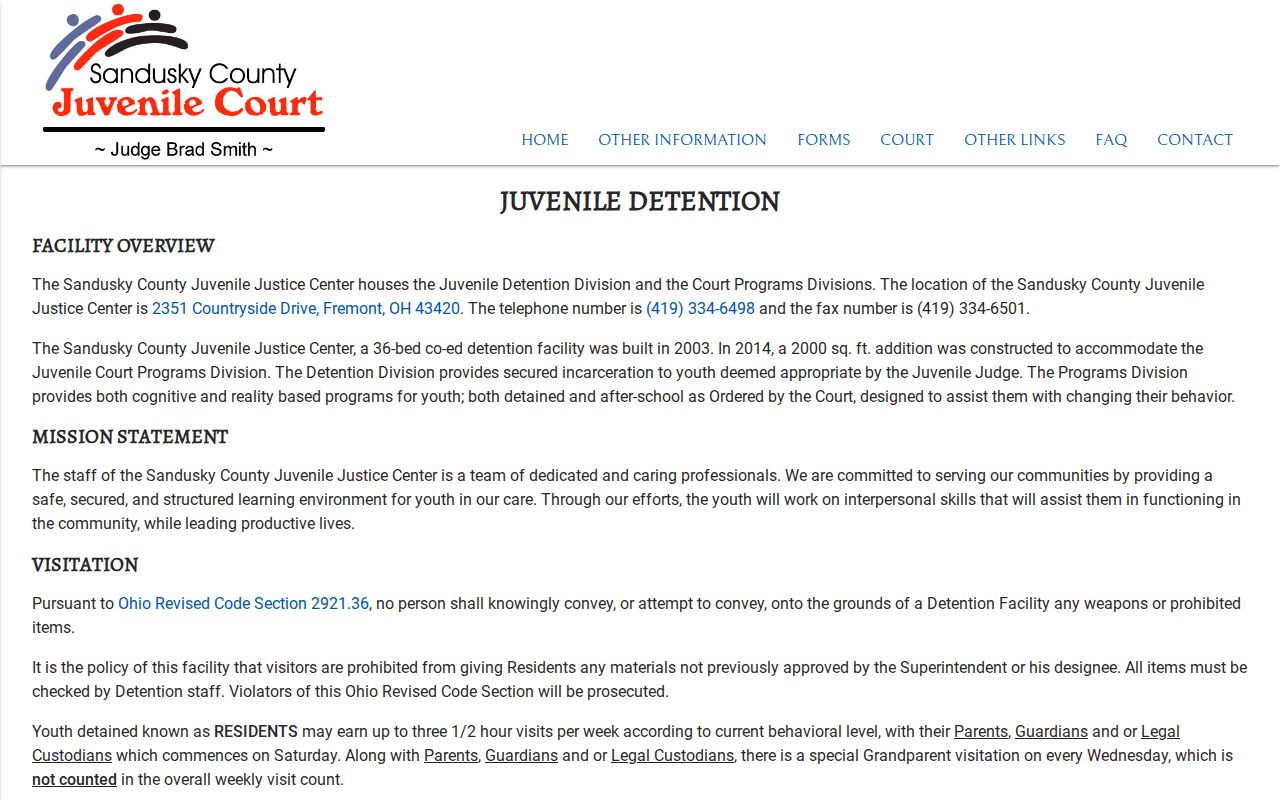
The source identifies a secure youth center, not a public released-youth search. Confidential placement questions still go through authorized court and facility channels.
Juvenile Center Release Record Boundaries
A release record for a youth cannot be treated like the adult jail's booking and custody record. Juvenile confidentiality, court orders, and the requester's authority shape what can be disclosed. The county public-record policy does not erase statutory limits. A person should not ask the sheriff to create a youth release report or seek adult jail fields for a juvenile case. The request belongs with Juvenile Court or the office the court identifies.
When information is available to an authorized person, the key issue is the nature of the change. Was the youth released to a custodian, transferred to treatment, placed in community corrections, or committed to DYS? The effective court order and the authorized placement information should agree. If another facility now has responsibility, use the handoff supplied by the committing court rather than searching broad public databases.
The general adult released-inmate search path on the Sandusky County home page is useful only for understanding why custody systems must be separated. Its adult jail, ODRC, and court routes do not authorize access to juvenile material. For this center, privacy and the court's directions control every release check.
Note: A public search failure cannot verify juvenile release, transfer, case closure, or the youth's current location.